The risk leaders can't see: why authenticity matters in regulated environments
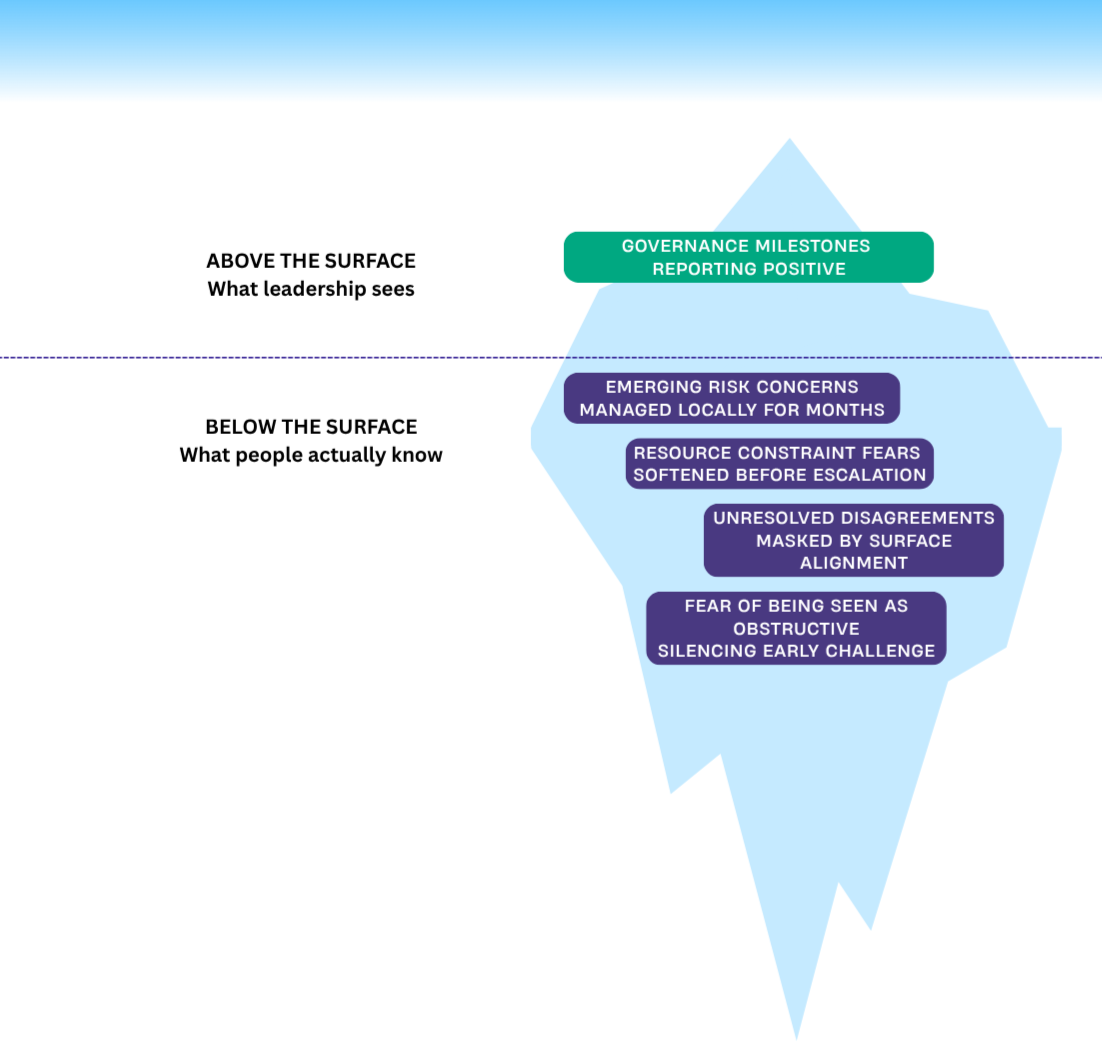
Authenticity is often described as a personal quality, a leadership style built on openness, honesty, and being true to oneself. In highly regulated environments, however, authenticity is something much more practical. It is the ability for people to raise concerns, share risks, challenge assumptions, and communicate reality without fear of unnecessary consequence.
Put simply, authenticity determines whether organisations have access to the information they need to make good decisions and in industries where patient safety, regulatory compliance, product quality, stakeholder confidence, and commercial performance all depend on effective decision-making, that matters.
This is why authenticity is not a "nice to have" in pharma, biotech, and other regulated industries. It is a cornerstone of risk management, trust, and organisational performance.
Yet many leadership teams do not realise they have an authenticity problem until the consequences begin to emerge. Issues surface late. Risks appear unexpectedly. Teams execute differently from what was agreed. Decisions take longer than they should. Leaders find themselves asking:
"If the right governance, processes, and controls are in place, why are we still being surprised?"
The problem is rarely compliance. It is visibility.
Most regulated organisations invest heavily in governance frameworks, controls, quality systems, and decision-making processes. These are essential. They reduce risk, provide accountability, and help organisations operate safely and effectively.
However, governance only works if leaders have access to reality. Many execution failures do not occur because organisations lack process. They occur because the information moving through those processes is incomplete, delayed, or filtered.
People know about emerging risks but choose to manage them locally. Concerns are softened before they reach leadership. Teams avoid challenging assumptions because they do not want to create friction or appear obstructive.
The result is that decisions are made using only part of the picture.
In one global pharmaceutical organisation, a significant transformation programme appeared to be progressing well. Governance milestones were being met and reporting remained positive. It was only when delivery timelines began to slip that leaders discovered multiple teams had been managing concerns about resource constraints for months. The issue was not that the organisation lacked visibility mechanisms. The issue was that people did not believe raising concerns would lead to constructive action.
The challenge was not compliance. It was visibility.
Why authenticity becomes harder as pressure increases
One of the reasons authenticity is often misunderstood is that organisations tend to need it most during periods of uncertainty. The very moments when it becomes hardest to sustain.
Restructures. Portfolio shifts. Cost pressures. Rapid growth. New leadership. Large-scale transformation. In these environments, people naturally become more cautious.
Not because they are unwilling to contribute, but because they are trying to navigate uncertainty. They are assessing how challenges will be received, whether concerns will be interpreted as negativity, and whether raising risks could create unintended consequences for themselves or their teams.
What was once discussed openly becomes more carefully managed. Concerns are raised later. Difficult conversations become less frequent. The organisation loses some of its ability to see itself clearly and that creates risk.
Three signs authenticity has become a performance issue
Authenticity is often discussed as a cultural concept. In practice, its absence creates very tangible operational consequences.
The first is delayed risk visibility. Teams identify concerns but hold onto them for too long. They try to solve problems locally before escalating them. By the time issues become visible to leadership, options have narrowed and the cost of intervention has increased.
The second is artificial alignment. Leadership teams leave meetings believing there is agreement, while underneath the surface different interpretations, concerns, and assumptions remain unresolved. Alignment appears stronger than it actually is.
The third is reduced decision quality. Without challenge, assumptions go untested. Without diverse perspectives, blind spots remain hidden. Decisions still get made, but they are often made with less insight than leaders realise.
None of these issues typically appear on risk registers. Yet all of them directly affect execution.
Why this matters in pharma and biotech
The consequences of these dynamics extend far beyond internal performance. In regulated industries, poor visibility of risk can affect regulatory interactions, inspection readiness, product quality, development timelines, commercial execution, and stakeholder confidence. Ultimately, it can affect patients.
Consider a development programme where concerns about feasibility are not raised early because teams believe timelines have already been committed externally. Or a manufacturing environment where operational pressures discourage teams from escalating emerging issues until they become significant enough to demand attention. The challenge is rarely a lack of capability. It is the delay between what people know and what leadership knows.
As organisations grow, this risk often increases. More governance is introduced. Decision pathways become more complex. More stakeholders become involved. Without deliberate leadership attention, authenticity can gradually decline while compliance remains strong. The organisation becomes well governed, but less visible.
What leaders who build trust and performance do differently
The most effective leaders understand that authenticity is not about encouraging people to speak up. It is about creating the conditions that make speaking up worthwhile.
People pay close attention to what happens when concerns are raised. They notice whether challenge is welcomed or dismissed. They observe whether difficult information leads to action or simply creates discomfort. Over time, these moments shape behaviour far more than any communication campaign.
The leaders who create high-performing environments actively test whether reality is reaching them. They seek out alternative perspectives. They ask where decisions are becoming harder than they should be. They explore where teams are experiencing friction that is not appearing in formal reporting.
Most importantly, they recognise that trust is built through response. When concerns are raised and addressed constructively, trust increases. When concerns are ignored or penalised, visibility decreases. Authenticity, therefore, becomes less about individual behaviour and more about organisational design.
The leadership trade-off many organisations miss
Senior leaders often face competing pressures. They want confidence, alignment, and speed. Yet all three can unintentionally suppress the very information they need most. The pursuit of certainty can discourage challenge. The pursuit of alignment can discourage disagreement. The pursuit of speed can discourage discussion. The organisations that consistently execute well understand this trade-off. They recognise thata difficult conversation today is often far less costly than a hidden issue tomorrow.
They understand that challenge may create short-term discomfort, but improves decision quality and reduces long-term risk. And they know that trust is not built when everything is going well. It is built when difficult truths can be shared safely and acted upon effectively.
A final reflection
Authenticity is often positioned as a leadership characteristic. In reality, it is much more than that. In regulated environments, authenticity determines how accurately organisations see themselves.
It influences risk visibility, decision quality, trust, execution performance, and ultimately organisational outcomes. The question for senior leaders is not whether people feel comfortable speaking up, but
"How confident are we that the information reaching leadership reflects the reality people are experiencing?"
Because in complex, highly regulated organisations, the greatest risks are rarely the ones that are visible. They are the ones that people saw coming but never felt able to raise.
In summary
Authenticity is a business capability that influences risk visibility, trust, decision quality, and execution performance. In regulated environments, where the consequences of missed signals can affect regulatory outcomes, commercial performance, stakeholder confidence, and patient impact, leaders need more than governance and process. They need access to reality. Organisations that create environments where concerns can be surfaced early, challenged constructively, and acted upon effectively are better positioned to manage risk, execute change, and sustain performance over time.