The hidden reimbursement risk between global, regional and affiliate teams
A reimbursement strategy can be technically robust, supported by strong evidence and aligned with the organisation’s commercial ambitions.
And yet, when it reaches individual markets, execution begins to fragment.
Affiliates question whether the evidence reflects local payer priorities. Regional teams try to reconcile different market needs. Global teams receive requests for additional analysis that they believed had already been addressed. Decisions slow down, assumptions diverge and local teams begin adapting the strategy independently to protect market timelines.
From a distance, this can look like a technical reimbursement challenge.
In practice, the greatest risk often sits elsewhere.
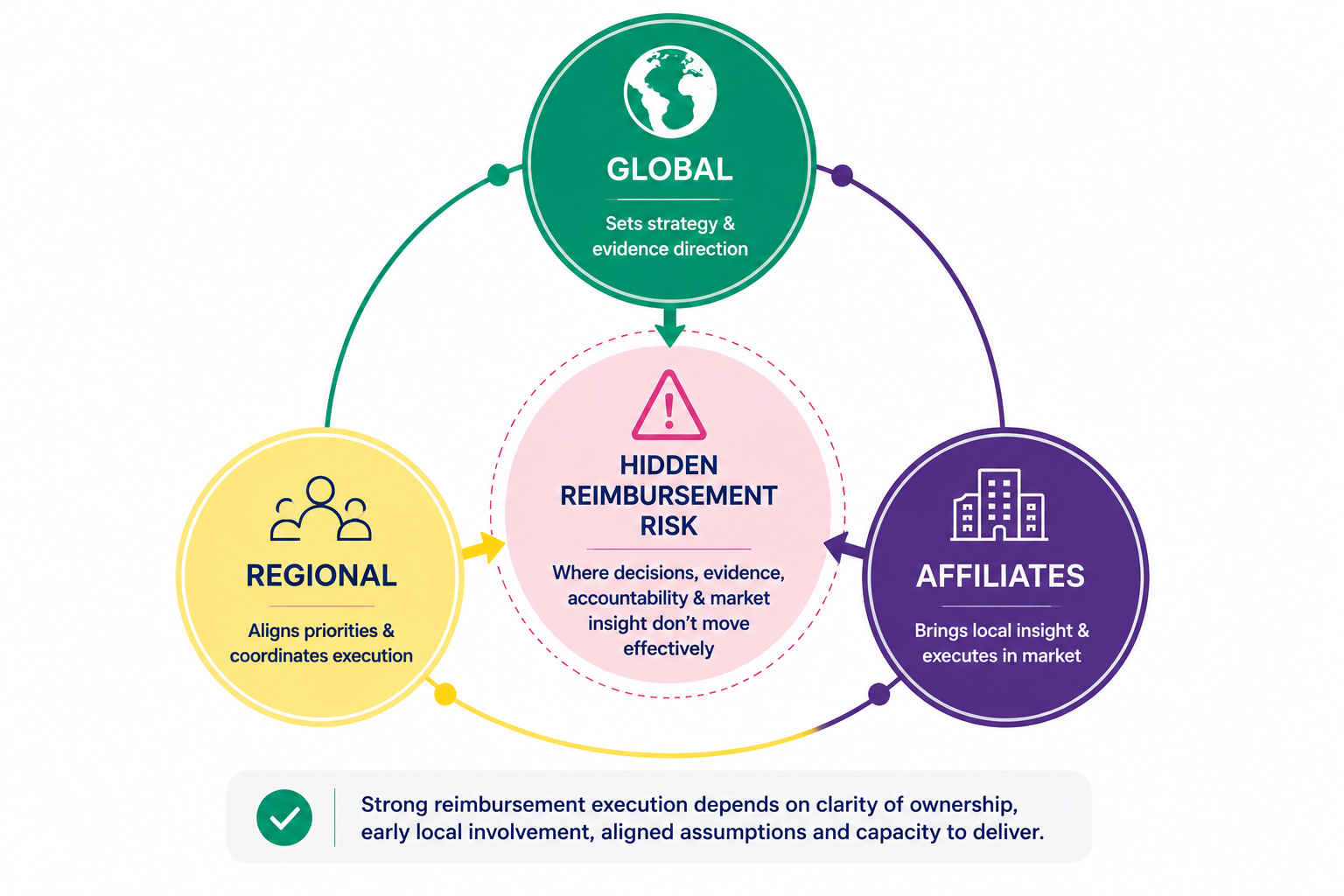
It sits in how decisions, evidence, accountability and market insight move between global, regional and affiliate teams.
A strong strategy does not guarantee strong execution
Reimbursement strategies are often developed with considerable technical rigour. Evidence requirements are assessed, value propositions are shaped, payer objections are anticipated and market access scenarios are modelled.
However, the strategy still needs to move through a complex organisational system before it can create value.
Global teams may hold responsibility for the overarching strategy and evidence plan. Regional teams are expected to identify common priorities and coordinate across markets. Affiliates bring the local payer insight needed to translate the strategy into submissions, negotiations and access outcomes.
Each layer has a legitimate perspective. The challenge is not whether those perspectives exist. It is whether the organisation has created an effective way to bring them together.
When this has not been addressed, the formal strategy may appear aligned while execution underneath it remains fragmented.
The risk is rarely visible in the final strategy document. It emerges through delayed decisions, repeated conversations, conflicting assumptions, late requests and uncertainty about who has the authority to resolve trade-offs.
Where reimbursement risk begins to build
One of the most common sources of friction is unclear ownership across organisational boundaries.
A global team may believe that the affiliate owns local adaptation. The affiliate may believe that global retains responsibility for decisions that could affect the wider value story. Regional colleagues may be expected to coordinate the two without having sufficient authority to resolve disagreement.
Ownership exists, but it is conditional.
As long as teams agree, work progresses. When evidence is limited, timelines tighten or priorities conflict, decision ownership becomes less clear precisely when it matters most.
This creates hesitation.
Teams seek additional alignment before acting. Decisions move upwards unnecessarily. Local concerns are raised repeatedly because nobody is certain whether they have been formally resolved. Global teams become drawn into operational detail, while affiliates wait for direction on issues they may be better placed to decide.
None of this necessarily appears as a failure. Meetings continue, plans are updated and activity remains high.
But reimbursement timelines become harder to protect and the strategy gradually loses consistency.
Local involvement is often early in theory and late in practice
Most organisations recognise the importance of affiliate insight. The difficulty is creating meaningful involvement at the point when local knowledge can still influence the strategy.
Affiliates may be invited to review evidence plans or global value materials, but only after the most consequential assumptions have already been established. Their involvement is technically early, but operationally late.
At this stage, local teams are often being asked to validate rather than shape.
This distinction matters because reimbursement environments are not interchangeable. Evidence that is persuasive in one market may carry less weight in another. Relevant comparators, payer expectations, assessment methodologies and negotiation dynamics differ. Affiliates can often see risks that are difficult to identify from a global perspective.
When those insights arrive late, the organisation faces an uncomfortable choice: revisit global work or ask the market to manage the gap locally.
The first creates delay and rework. The second creates inconsistency and risk.
Effective involvement is not about including every market in every conversation. It is about identifying which markets hold relevant insight, when their input is required and how it will influence the decision.
Competing assumptions create invisible misalignment
Global, regional and affiliate teams can appear aligned while working from different assumptions.
Global teams may be optimising for a consistent evidence platform across markets. Regional teams may be balancing sequencing and common requirements. Affiliates may be responding to immediate payer expectations and launch pressures.
All three can support the same strategic objective while making different trade-offs.
Without explicitly surfacing these assumptions, disagreement is often interpreted as resistance, insufficient understanding or a lack of strategic alignment. Teams respond by increasing communication, adding meetings or producing further guidance. More communication does not resolve different assumptions unless those assumptions are made visible.
The more useful questions are:
What is each team optimising for?
Which constraints are fixed and which are open to challenge?
Where is local variation strategically necessary?
What degree of reimbursement risk is the organisation prepared to accept?
Who decides when global consistency and local relevance pull in different directions?
These conversations can feel more difficult than reviewing the strategy itself. They are also where many of the most significant execution risks can be resolved.
Capacity is part of reimbursement strategy
Organisations often assess whether a market has the technical capability to execute a reimbursement strategy. Less attention is given to whether teams have the organisational capacity to do so.
An affiliate may understand the strategy but lack sufficient time, resources or cross-functional support to implement it effectively. Regional teams may be coordinating a large number of markets without the authority or capacity to address each market’s challenges. Global teams may be supporting multiple assets and indications simultaneously, limiting how quickly they can respond.
When capacity is constrained, teams naturally prioritise immediate deliverables.
Local workarounds emerge. Important questions are postponed. Evidence gaps are addressed reactively. The organisation may then interpret inconsistent execution as a capability issue when the underlying problem is overload.
A strategy that cannot be executed within the available capacity is not yet an executable strategy.
This does not mean every market needs more resources. It means the organisation must make deliberate choices about where support is most important, which activities can be standardised and what will be deprioritised.
How to recognise hidden reimbursement risk
The risk between global, regional and affiliate teams is often visible before it affects an external milestone.
The 6 warning signs:
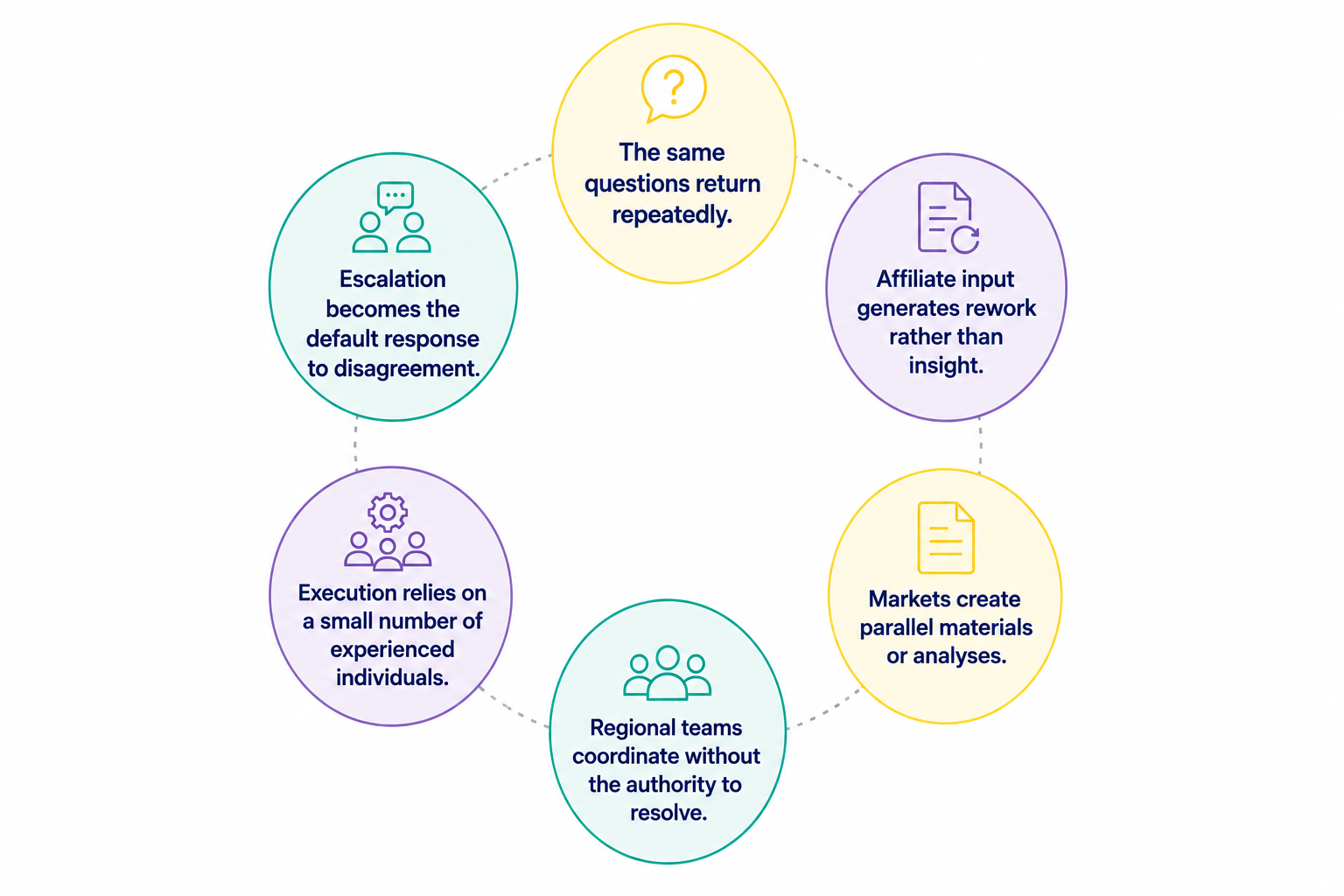
Individually, these may appear manageable. Together, they point to a reimbursement strategy whose organisational foundations are weaker than its technical foundations.
What senior leaders can do differently?
The answer is rarely another governance layer.
Senior leaders can start by clarifying the decisions that genuinely require global consistency, those that should be shaped regionally and those best owned by affiliates. This needs to go beyond role descriptions and address what happens when teams disagree or new evidence changes the assumptions.
They can also create earlier feedback loops with selected markets. The objective is not universal consultation. It is to introduce relevant local insight while strategic choices can still be influenced.
Capacity should be tested alongside capability. Leaders need visibility of where teams are absorbing competing priorities, where timelines depend on workarounds and where local execution requires more support than the formal plan acknowledges.
Finally, leaders need to examine the signals the organisation reinforces. If teams are encouraged to take ownership but every difficult decision is escalated, they will learn to wait. If local insight is described as essential but rarely changes global assumptions, affiliates will disengage or adapt independently.
The organisation responds less to what the operating model says and more to what happens when pressure increases.
A different way to think about reimbursement risk
Reimbursement risk is often framed in terms of evidence, payer requirements, pricing pressure or market uncertainty.
All are important. But they are not the whole picture.
A technically strong strategy can still underperform if the organisation cannot move insight, decisions and accountability effectively across its global, regional and affiliate teams.
A useful leadership question to consider is:
“Have we created the organisational conditions that allow this strategy to be interpreted, challenged and executed consistently across markets?”
In summary
The greatest reimbursement risks are not always visible in the formal strategy. They sit in unclear ownership, competing assumptions, late local involvement, slow decisions and insufficient organisational capacity.
Strong reimbursement execution requires more than technical expertise. It requires clarity about who decides, where local insight shapes the strategy and how trade-offs are resolved across global, regional and affiliate teams.
When those conditions are in place, the organisation can respond to market complexity without losing consistency, speed or confidence.