

Who owns decisions when commercial transformation crosses functions?
Collaboration and decision ownership are not the same
Cross-functional collaboration is essential in pharma. No single function holds all the information required to make complex commercial decisions.
However, collaboration can create the impression that accountability is shared equally.
It rarely is.
A decision may require input from medical, regulatory, market access and finance, but that does not mean all four functions own the final choice. When the distinction between contribution and decision ownership is not explicit, teams attempt to reach complete consensus.
Consensus can be valuable, but it is not always possible or necessary.
Different functions are often optimising for different outcomes. Commercial may prioritise speed and market opportunity. Medical may focus on scientific integrity and stakeholder credibility. Regulatory may seek to protect the product’s licence and future options. Finance may require confidence in the expected return. Affiliates may be responding to immediate local realities.
These perspectives should create better decisions. Without clear ownership, they can also create delay.
The challenge is not getting everyone to agree. It is creating a process through which relevant perspectives inform a decision that someone is clearly accountable for making.
Why ownership becomes blurred
Decision ownership is usually clearest within individual functions. It becomes more ambiguous at the boundaries between them.
Commercial transformation creates more of these boundaries.
A change to the customer engagement model may affect commercial operations, medical interactions, technology, data governance and affiliate capability. A new approach to evidence generation may influence market access, medical strategy, regulatory commitments, R&D priorities and investment decisions.
The organisation may assign an executive sponsor or programme lead, but this does not automatically clarify who owns each cross-functional decision underneath the transformation.
Programme leaders can become responsible for moving the work forward without having the authority to resolve the most important trade-offs. Functional leaders retain formal accountability but may not see themselves as owners of the integrated outcome.
The result is accountability without authority in one part of the organisation and authority without integrated accountability in another.
When decisions become difficult, they move upwards.
More governance can disguise the problem
When transformation slows, organisations often strengthen governance.
Additional steering groups are created. More functions are represented. New forums are introduced to improve coordination and visibility.
This can help, but it can also make ownership harder to see.
A governance forum may review a recommendation without being clear whether its purpose is to advise, endorse or decide. A steering committee may approve a direction while individual functions retain the ability to reopen it. Senior leaders may believe authority has been delegated, while teams underneath continue to seek their confirmation.
The result is governance activity without decision confidence.
Teams invest significant time preparing for meetings, aligning stakeholders and refining materials. Yet the decision still requires several conversations outside the formal forum before anyone feels confident acting.
The problem is not necessarily insufficient governance. It is that the governance has not been designed around the decisions the transformation requires.
Decision rights need to work under pressure
Many transformations define roles at the beginning of the programme. Responsibility matrices are created and governance structures are documented.
These arrangements often work while priorities remain aligned.
Their real test comes when functions disagree.
Who decides when speed conflicts with evidence requirements? Who resolves differences between global consistency and affiliate flexibility? Who determines whether a strategic opportunity justifies additional investment? Who can stop existing work when the transformation introduces a new priority?
If these questions have not been addressed, ownership becomes conditional. Teams can make decisions only when those decisions carry limited risk or attract broad agreement.
The most consequential choices are then escalated.
This teaches the organisation that ownership is expected in principle but potentially unsafe in practice. People become more cautious, seek wider validation and spend longer building support before making recommendations.
The result is not a lack of accountability. It is hesitation created by an unclear decision environment.
The hidden role of competing priorities
Commercial transformation rarely replaces existing delivery. It is added alongside it.
Functional leaders remain accountable for business performance, evidence plans, regulatory commitments, budgets and market priorities while also contributing people and attention to the transformation.
This creates a predictable tension.
At the enterprise level, the transformation may be described as a strategic priority. Within individual functions, it competes with commitments that remain equally visible and measurable.
Without explicit trade-offs, leaders resolve this tension locally.
Functions protect the work for which they will be held most directly accountable. Transformation activity continues, but receives intermittent attention. Decisions are delayed because contributors are unavailable. Programme teams compensate by increasing coordination and follow-up.
From a governance perspective, the transformation remains on track. From an execution perspective, momentum is becoming increasingly difficult to sustain.
Clear ownership therefore requires more than naming a decision-maker. It requires alignment around which priorities take precedence and what the organisation is prepared to stop, delay or simplify.
Signs that decision ownership is not working
Several patterns indicate that cross-functional ownership may be unclear:
Decisions are repeatedly reopened.
Teams leave a meeting with apparent agreement, but the discussion restarts when another leader or function becomes involved.
Escalation is frequent but resolution is slow.
Issues move upwards without a clear route to a final decision.
Programme leads coordinate more than they decide.
They carry accountability for progress but lack authority over the trade-offs affecting it.
Functional approval is confused with cross-functional contribution.
Every function is treated as having a veto, even when its role should be advisory.
The organisation relies on consensus for high-stakes choices.
Difficult decisions remain open because complete agreement cannot be reached.
Meetings produce actions but not commitments.
Work is assigned, but the underlying strategic choice remains unresolved.
Teams continue to seek informal confirmation.
A decision has technically been made, but people do not feel safe acting on it.
These are not simply process issues. They are signals that the organisation has not aligned authority, accountability and risk.
Designing for decisions rather than meetings
Effective decision ownership starts with identifying the decisions that will determine whether the transformation succeeds.
These might include investment choices, market sequencing, evidence priorities, changes to customer engagement, technology adoption, resource allocation or the balance between global standardisation and local flexibility.
For each decision, leaders need to establish:
Who holds final decision authority?
Which functions must contribute expertise?
Who is responsible for translating the decision into action?
What criteria will be used to resolve competing priorities?
What sits within the decision-maker’s authority and what genuinely requires escalation?
How will the decision and its rationale be communicated?
This creates something more useful than a general responsibility matrix. It creates a practical decision architecture.
The objective is not to remove challenge. Good decisions require constructive challenge, particularly in environments where scientific, regulatory, commercial and patient considerations intersect.
The objective is to make challenge part of the decision process without allowing it to remove ownership from the decision-maker.
What senior leaders need to reinforce
Formal clarity will only work if leadership behaviour supports it.
If senior leaders delegate decisions and then routinely revisit them, authority will quickly move back upwards. If functions are told to collaborate but rewarded only for protecting functional outcomes, enterprise trade-offs will remain difficult. If programme leaders are held accountable for progress but cannot access timely decisions, coordination will replace leadership.
Senior leaders shape decision ownership through what they question, reinforce and tolerate.
They can strengthen the environment by making decision boundaries explicit, supporting leaders when reasonable choices carry risk and ensuring that disagreement is resolved through agreed criteria rather than organisational influence.
They also need to communicate why a decision was made.
Cross-functional teams are more likely to act with confidence when they understand not only the outcome but also the assumptions, evidence and trade-offs behind it. This reduces the likelihood that the decision will be reinterpreted or reopened as it moves through the organisation.
A different question for commercial transformation
The success of commercial transformation is not determined by how many functions participate or how frequently they meet.
It is determined by whether the organisation can bring together different perspectives and still make clear, timely choices.
The most useful leadership question is not:
“Are our functions collaborating effectively?”
It is:
“When priorities conflict, does everyone know who decides, how the decision will be made and what happens next?”
In summary
Commercial transformation requires cross-functional contribution, but cross-functional contribution does not mean shared decision ownership.
When authority, accountability and functional input are not clearly distinguished, decisions slow down, governance expands and important choices are repeatedly reopened.
Effective transformation creates clarity about who decides, who contributes, how competing priorities are resolved and what teams are empowered to act on without further escalation.
Collaboration creates the quality of insight. Clear ownership turns that insight into progress.

The hidden reimbursement risk between global, regional and affiliate teams
A reimbursement strategy can be technically robust, supported by strong evidence and aligned with the organisation’s commercial ambitions.
And yet, when it reaches individual markets, execution begins to fragment.
Affiliates question whether the evidence reflects local payer priorities. Regional teams try to reconcile different market needs. Global teams receive requests for additional analysis that they believed had already been addressed. Decisions slow down, assumptions diverge and local teams begin adapting the strategy independently to protect market timelines.
From a distance, this can look like a technical reimbursement challenge.
In practice, the greatest risk often sits elsewhere.
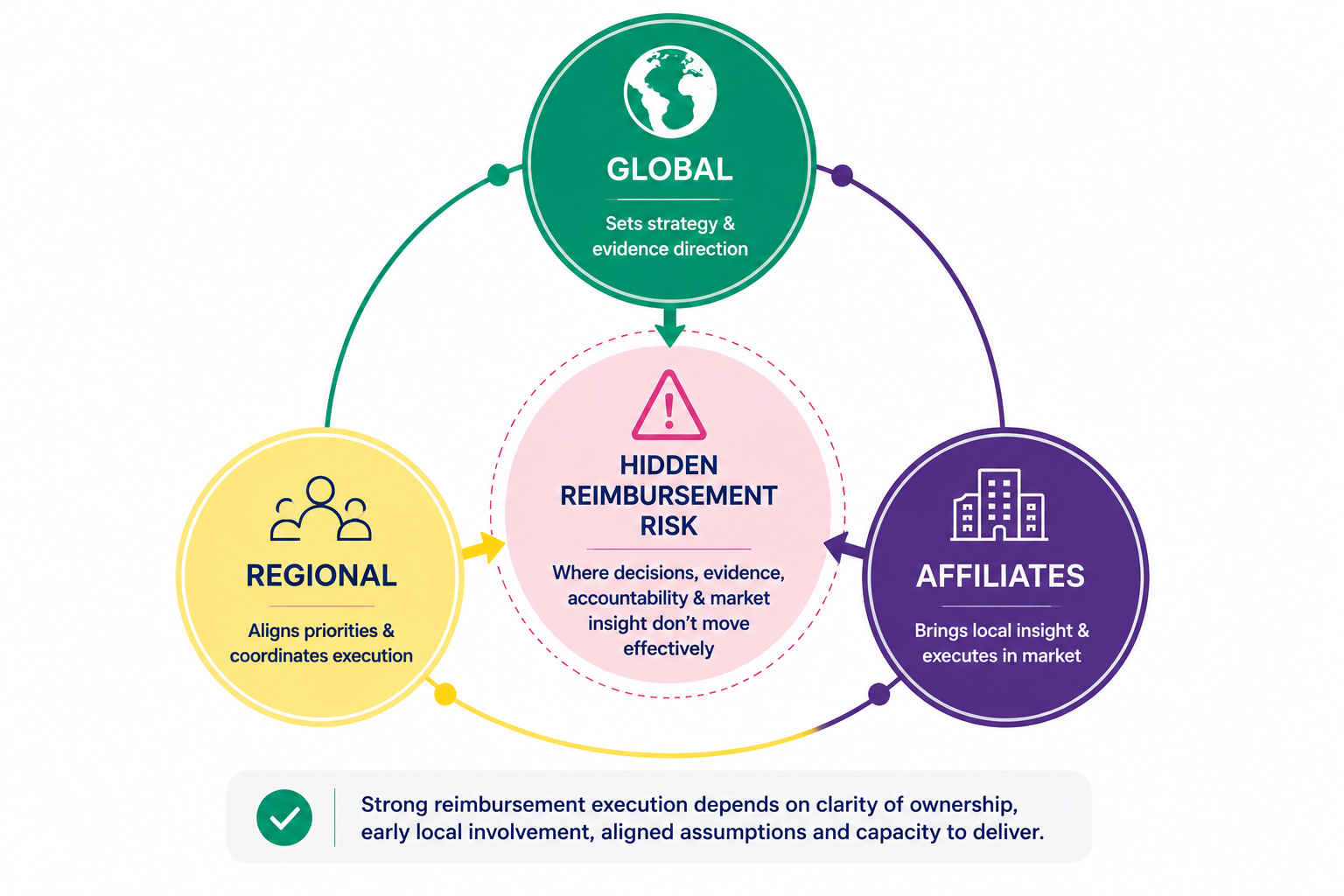
It sits in how decisions, evidence, accountability and market insight move between global, regional and affiliate teams.
A strong strategy does not guarantee strong execution
Reimbursement strategies are often developed with considerable technical rigour. Evidence requirements are assessed, value propositions are shaped, payer objections are anticipated and market access scenarios are modelled.
However, the strategy still needs to move through a complex organisational system before it can create value.
Global teams may hold responsibility for the overarching strategy and evidence plan. Regional teams are expected to identify common priorities and coordinate across markets. Affiliates bring the local payer insight needed to translate the strategy into submissions, negotiations and access outcomes.
Each layer has a legitimate perspective. The challenge is not whether those perspectives exist. It is whether the organisation has created an effective way to bring them together.
When this has not been addressed, the formal strategy may appear aligned while execution underneath it remains fragmented.
The risk is rarely visible in the final strategy document. It emerges through delayed decisions, repeated conversations, conflicting assumptions, late requests and uncertainty about who has the authority to resolve trade-offs.
Where reimbursement risk begins to build
One of the most common sources of friction is unclear ownership across organisational boundaries.
A global team may believe that the affiliate owns local adaptation. The affiliate may believe that global retains responsibility for decisions that could affect the wider value story. Regional colleagues may be expected to coordinate the two without having sufficient authority to resolve disagreement.
Ownership exists, but it is conditional.
As long as teams agree, work progresses. When evidence is limited, timelines tighten or priorities conflict, decision ownership becomes less clear precisely when it matters most.
This creates hesitation.
Teams seek additional alignment before acting. Decisions move upwards unnecessarily. Local concerns are raised repeatedly because nobody is certain whether they have been formally resolved. Global teams become drawn into operational detail, while affiliates wait for direction on issues they may be better placed to decide.
None of this necessarily appears as a failure. Meetings continue, plans are updated and activity remains high.
But reimbursement timelines become harder to protect and the strategy gradually loses consistency.
Local involvement is often early in theory and late in practice
Most organisations recognise the importance of affiliate insight. The difficulty is creating meaningful involvement at the point when local knowledge can still influence the strategy.
Affiliates may be invited to review evidence plans or global value materials, but only after the most consequential assumptions have already been established. Their involvement is technically early, but operationally late.
At this stage, local teams are often being asked to validate rather than shape.
This distinction matters because reimbursement environments are not interchangeable. Evidence that is persuasive in one market may carry less weight in another. Relevant comparators, payer expectations, assessment methodologies and negotiation dynamics differ. Affiliates can often see risks that are difficult to identify from a global perspective.
When those insights arrive late, the organisation faces an uncomfortable choice: revisit global work or ask the market to manage the gap locally.
The first creates delay and rework. The second creates inconsistency and risk.
Effective involvement is not about including every market in every conversation. It is about identifying which markets hold relevant insight, when their input is required and how it will influence the decision.
Competing assumptions create invisible misalignment
Global, regional and affiliate teams can appear aligned while working from different assumptions.
Global teams may be optimising for a consistent evidence platform across markets. Regional teams may be balancing sequencing and common requirements. Affiliates may be responding to immediate payer expectations and launch pressures.
All three can support the same strategic objective while making different trade-offs.
Without explicitly surfacing these assumptions, disagreement is often interpreted as resistance, insufficient understanding or a lack of strategic alignment. Teams respond by increasing communication, adding meetings or producing further guidance. More communication does not resolve different assumptions unless those assumptions are made visible.
The more useful questions are:
What is each team optimising for?
Which constraints are fixed and which are open to challenge?
Where is local variation strategically necessary?
What degree of reimbursement risk is the organisation prepared to accept?
Who decides when global consistency and local relevance pull in different directions?
These conversations can feel more difficult than reviewing the strategy itself. They are also where many of the most significant execution risks can be resolved.
Capacity is part of reimbursement strategy
Organisations often assess whether a market has the technical capability to execute a reimbursement strategy. Less attention is given to whether teams have the organisational capacity to do so.
An affiliate may understand the strategy but lack sufficient time, resources or cross-functional support to implement it effectively. Regional teams may be coordinating a large number of markets without the authority or capacity to address each market’s challenges. Global teams may be supporting multiple assets and indications simultaneously, limiting how quickly they can respond.
When capacity is constrained, teams naturally prioritise immediate deliverables.
Local workarounds emerge. Important questions are postponed. Evidence gaps are addressed reactively. The organisation may then interpret inconsistent execution as a capability issue when the underlying problem is overload.
A strategy that cannot be executed within the available capacity is not yet an executable strategy.
This does not mean every market needs more resources. It means the organisation must make deliberate choices about where support is most important, which activities can be standardised and what will be deprioritised.
How to recognise hidden reimbursement risk
The risk between global, regional and affiliate teams is often visible before it affects an external milestone.
The 6 warning signs:
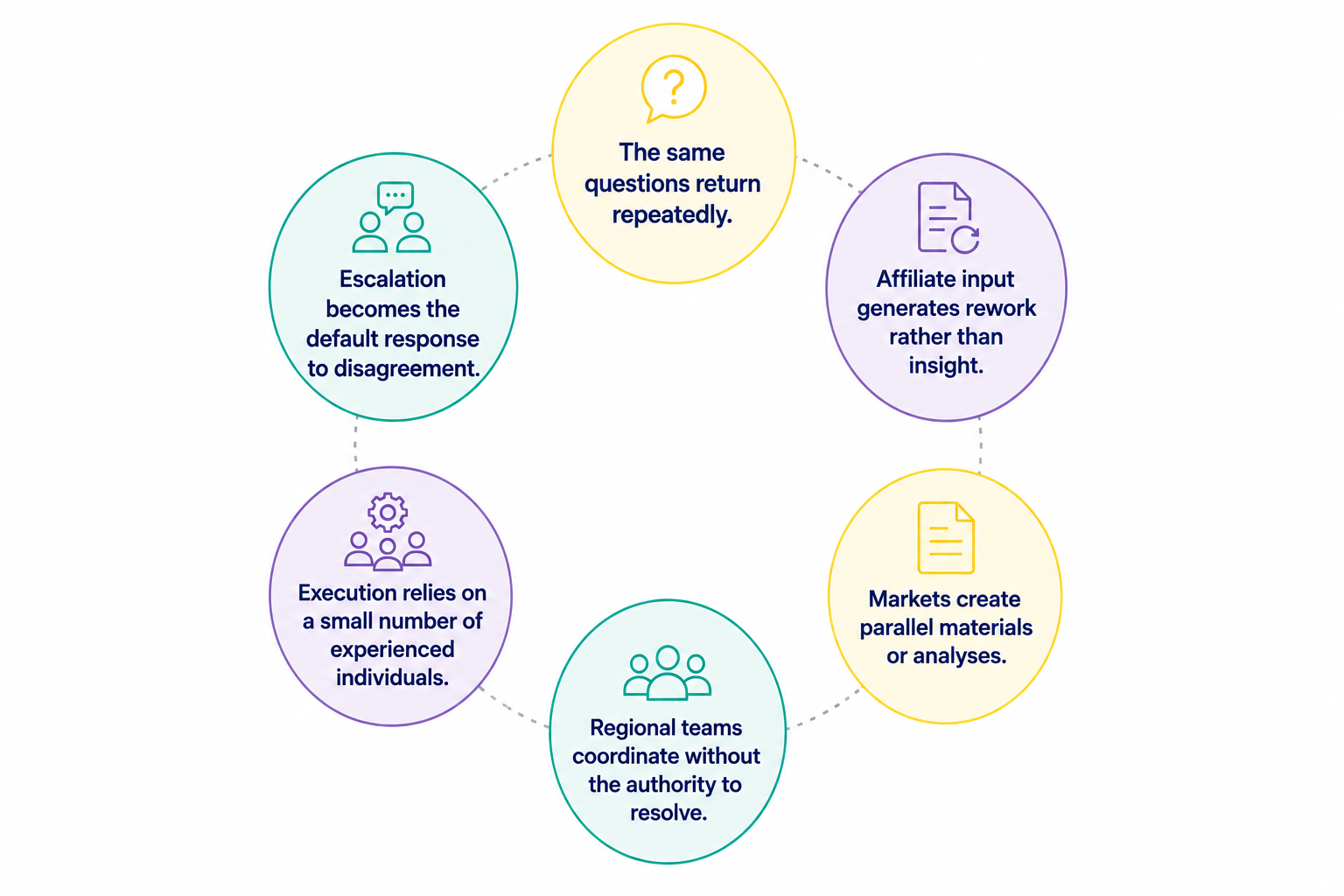
Individually, these may appear manageable. Together, they point to a reimbursement strategy whose organisational foundations are weaker than its technical foundations.
What senior leaders can do differently?
The answer is rarely another governance layer.
Senior leaders can start by clarifying the decisions that genuinely require global consistency, those that should be shaped regionally and those best owned by affiliates. This needs to go beyond role descriptions and address what happens when teams disagree or new evidence changes the assumptions.
They can also create earlier feedback loops with selected markets. The objective is not universal consultation. It is to introduce relevant local insight while strategic choices can still be influenced.
Capacity should be tested alongside capability. Leaders need visibility of where teams are absorbing competing priorities, where timelines depend on workarounds and where local execution requires more support than the formal plan acknowledges.
Finally, leaders need to examine the signals the organisation reinforces. If teams are encouraged to take ownership but every difficult decision is escalated, they will learn to wait. If local insight is described as essential but rarely changes global assumptions, affiliates will disengage or adapt independently.
The organisation responds less to what the operating model says and more to what happens when pressure increases.
A different way to think about reimbursement risk
Reimbursement risk is often framed in terms of evidence, payer requirements, pricing pressure or market uncertainty.
All are important. But they are not the whole picture.
A technically strong strategy can still underperform if the organisation cannot move insight, decisions and accountability effectively across its global, regional and affiliate teams.
A useful leadership question to consider is:
“Have we created the organisational conditions that allow this strategy to be interpreted, challenged and executed consistently across markets?”
In summary
The greatest reimbursement risks are not always visible in the formal strategy. They sit in unclear ownership, competing assumptions, late local involvement, slow decisions and insufficient organisational capacity.
Strong reimbursement execution requires more than technical expertise. It requires clarity about who decides, where local insight shapes the strategy and how trade-offs are resolved across global, regional and affiliate teams.
When those conditions are in place, the organisation can respond to market complexity without losing consistency, speed or confidence.

The risk leaders can't see: why authenticity matters in regulated environments
The risk leaders can't see: why authenticity matters in regulated environments
Authenticity is often described as a personal quality, a leadership style built on openness, honesty, and being true to oneself. In highly regulated environments, however, authenticity is something much more practical. It is the ability for people to raise concerns, share risks, challenge assumptions, and communicate reality without fear of unnecessary consequence.
Put simply, authenticity determines whether organisations have access to the information they need to make good decisions and in industries where patient safety, regulatory compliance, product quality, stakeholder confidence, and commercial performance all depend on effective decision-making, that matters.
This is why authenticity is not a "nice to have" in pharma, biotech, and other regulated industries. It is a cornerstone of risk management, trust, and organisational performance.
Yet many leadership teams do not realise they have an authenticity problem until the consequences begin to emerge. Issues surface late. Risks appear unexpectedly. Teams execute differently from what was agreed. Decisions take longer than they should. Leaders find themselves asking:
"If the right governance, processes, and controls are in place, why are we still being surprised?"
The problem is rarely compliance. It is visibility.
Most regulated organisations invest heavily in governance frameworks, controls, quality systems, and decision-making processes. These are essential. They reduce risk, provide accountability, and help organisations operate safely and effectively.
However, governance only works if leaders have access to reality. Many execution failures do not occur because organisations lack process. They occur because the information moving through those processes is incomplete, delayed, or filtered.
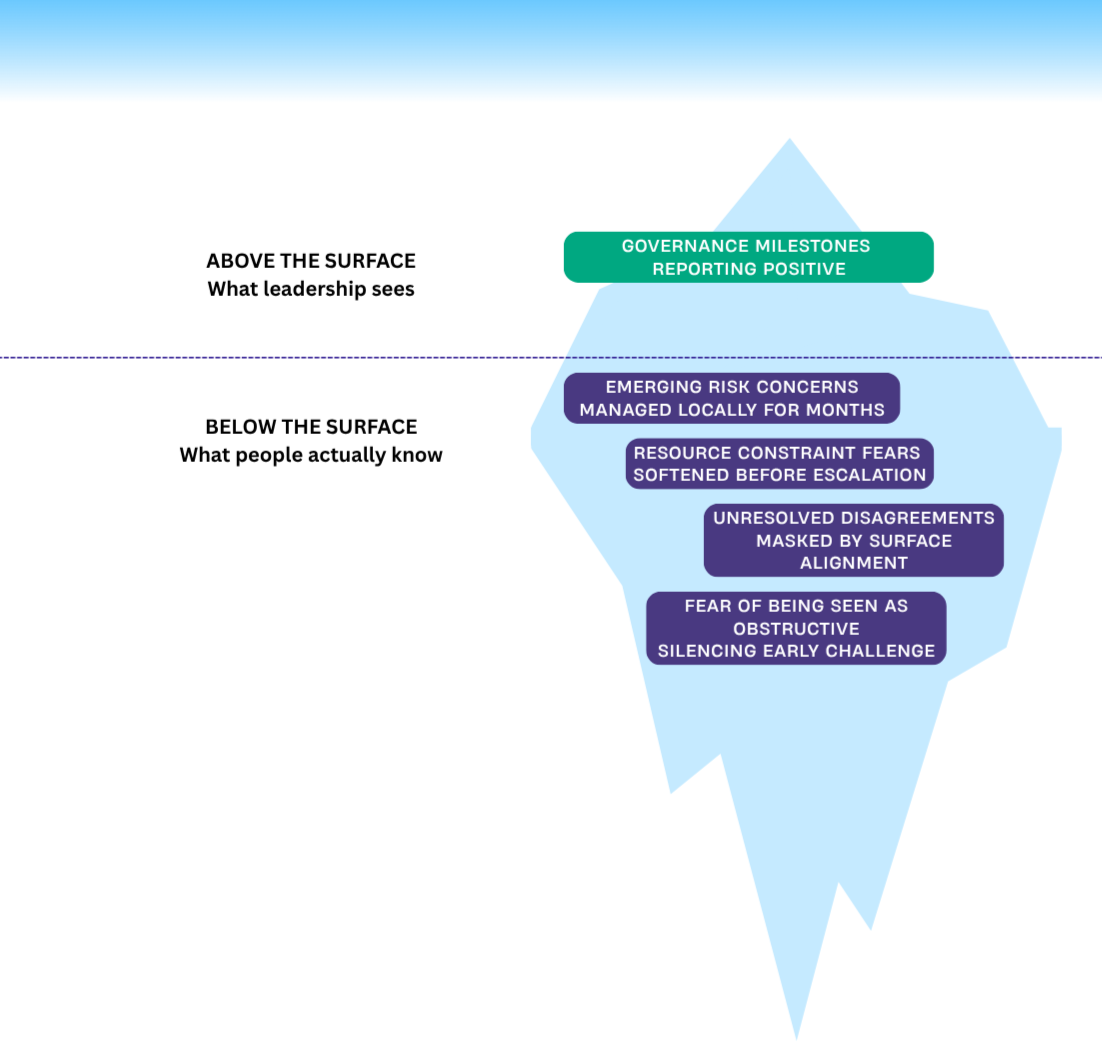
People know about emerging risks but choose to manage them locally. Concerns are softened before they reach leadership. Teams avoid challenging assumptions because they do not want to create friction or appear obstructive.
The result is that decisions are made using only part of the picture.
In one global pharmaceutical organisation, a significant transformation programme appeared to be progressing well. Governance milestones were being met and reporting remained positive. It was only when delivery timelines began to slip that leaders discovered multiple teams had been managing concerns about resource constraints for months. The issue was not that the organisation lacked visibility mechanisms. The issue was that people did not believe raising concerns would lead to constructive action.
The challenge was not compliance. It was visibility.
Why authenticity becomes harder as pressure increases
One of the reasons authenticity is often misunderstood is that organisations tend to need it most during periods of uncertainty. The very moments when it becomes hardest to sustain.
Restructures. Portfolio shifts. Cost pressures. Rapid growth. New leadership. Large-scale transformation. In these environments, people naturally become more cautious.
Not because they are unwilling to contribute, but because they are trying to navigate uncertainty. They are assessing how challenges will be received, whether concerns will be interpreted as negativity, and whether raising risks could create unintended consequences for themselves or their teams.
What was once discussed openly becomes more carefully managed. Concerns are raised later. Difficult conversations become less frequent. The organisation loses some of its ability to see itself clearly and that creates risk.
Three signs authenticity has become a performance issue
Authenticity is often discussed as a cultural concept. In practice, its absence creates very tangible operational consequences.
The first is delayed risk visibility. Teams identify concerns but hold onto them for too long. They try to solve problems locally before escalating them. By the time issues become visible to leadership, options have narrowed and the cost of intervention has increased.
The second is artificial alignment. Leadership teams leave meetings believing there is agreement, while underneath the surface different interpretations, concerns, and assumptions remain unresolved. Alignment appears stronger than it actually is.
The third is reduced decision quality. Without challenge, assumptions go untested. Without diverse perspectives, blind spots remain hidden. Decisions still get made, but they are often made with less insight than leaders realise.
None of these issues typically appear on risk registers. Yet all of them directly affect execution.
Why this matters in pharma and biotech
The consequences of these dynamics extend far beyond internal performance. In regulated industries, poor visibility of risk can affect regulatory interactions, inspection readiness, product quality, development timelines, commercial execution, and stakeholder confidence. Ultimately, it can affect patients.
Consider a development programme where concerns about feasibility are not raised early because teams believe timelines have already been committed externally. Or a manufacturing environment where operational pressures discourage teams from escalating emerging issues until they become significant enough to demand attention. The challenge is rarely a lack of capability. It is the delay between what people know and what leadership knows.
As organisations grow, this risk often increases. More governance is introduced. Decision pathways become more complex. More stakeholders become involved. Without deliberate leadership attention, authenticity can gradually decline while compliance remains strong. The organisation becomes well governed, but less visible.
What leaders who build trust and performance do differently
The most effective leaders understand that authenticity is not about encouraging people to speak up. It is about creating the conditions that make speaking up worthwhile.
People pay close attention to what happens when concerns are raised. They notice whether challenge is welcomed or dismissed. They observe whether difficult information leads to action or simply creates discomfort. Over time, these moments shape behaviour far more than any communication campaign.
The leaders who create high-performing environments actively test whether reality is reaching them. They seek out alternative perspectives. They ask where decisions are becoming harder than they should be. They explore where teams are experiencing friction that is not appearing in formal reporting.
Most importantly, they recognise that trust is built through response. When concerns are raised and addressed constructively, trust increases. When concerns are ignored or penalised, visibility decreases. Authenticity, therefore, becomes less about individual behaviour and more about organisational design.
The leadership trade-off many organisations miss
Senior leaders often face competing pressures. They want confidence, alignment, and speed. Yet all three can unintentionally suppress the very information they need most. The pursuit of certainty can discourage challenge. The pursuit of alignment can discourage disagreement. The pursuit of speed can discourage discussion. The organisations that consistently execute well understand this trade-off. They recognise thata difficult conversation today is often far less costly than a hidden issue tomorrow.
They understand that challenge may create short-term discomfort, but improves decision quality and reduces long-term risk. And they know that trust is not built when everything is going well. It is built when difficult truths can be shared safely and acted upon effectively.
A final reflection
Authenticity is often positioned as a leadership characteristic. In reality, it is much more than that. In regulated environments, authenticity determines how accurately organisations see themselves.
It influences risk visibility, decision quality, trust, execution performance, and ultimately organisational outcomes. The question for senior leaders is not whether people feel comfortable speaking up, but
"How confident are we that the information reaching leadership reflects the reality people are experiencing?"
Because in complex, highly regulated organisations, the greatest risks are rarely the ones that are visible. They are the ones that people saw coming but never felt able to raise.
In summary
Authenticity is a business capability that influences risk visibility, trust, decision quality, and execution performance. In regulated environments, where the consequences of missed signals can affect regulatory outcomes, commercial performance, stakeholder confidence, and patient impact, leaders need more than governance and process. They need access to reality. Organisations that create environments where concerns can be surfaced early, challenged constructively, and acted upon effectively are better positioned to manage risk, execute change, and sustain performance over time.

Most restructures redesign the organisation. Few rebuild execution
It All Begins Here

The expected return on that investment is clear: greater focus, improved efficiency, faster decision-making, and stronger execution.
Restructuring decisions are rarely taken lightly. In pharma and biotech organisations, they often involve months of strategic review, significant leadership attention, complex workforce decisions, and millions of pounds of investment intended to reposition the organisation for future growth, portfolio shifts, operational sustainability, or a new strategic direction.
While most restructures successfully change the organisation chart, far fewer rebuild the conditions that allow execution to continue effectively afterwards. And this is where a critical issue begins to emerge. The real risk is rarely the restructure itself. The risk is what happens afterwards.
The hidden challenge behind restructuring
Most restructures are built around a relatively straightforward assumption: changing the structure will improve organisational performance. Functions are consolidated, layers removed, reporting lines simplified, and costs reduced in the expectation that the organisation will become more focused and effective as a result.
In practice, however, many restructures improve structural efficiency while unintentionally weakening execution. And when execution weakens, the expected return on the restructuring investment becomes significantly harder to realise.
This is particularly true in pharma and biotech environments, where execution depends heavily on cross-functional coordination, scientific judgement, regulatory alignment, and informal networks of expertise that sit beyond formal reporting lines. Work in these organisations rarely moves neatly through organisation charts. It moves through relationships, routines, trust, and accumulated understanding built over time. Restructures interrupt all of them.
In one emerging biotech preparing to scale beyond its original R&D footprint, a more formal functional structure was introduced to support growth and investor confidence. Accountability became clearer on paper, but decision-making slowed as many of the informal problem-solving dynamics that had previously enabled rapid progress disappeared almost overnight.
The structure had evolved, but the organisation’s ability to execute within it had not. The leaders who protect restructuring ROI understand that redesigning the organisation is only part of the challenge. Rebuilding the conditions for execution is what ultimately determines whether value is realised.
Why execution risk increases after restructuring
Most restructuring programmes focus heavily on visible elements: organisation charts, cost logic, leadership announcements, and role definitions. Far less attention is typically paid to what might be described as the organisation’s execution architecture—how decisions get made in practice, how ownership operates across boundaries, how priorities are reinforced, and how teams maintain momentum under pressure.
This matters because restructures do not simply remove roles or redraw reporting lines. They disrupt patterns of behaviour that previously allowed work to move effectively through the organisation. Teams may retain all the formal capabilities required to deliver, while simultaneously losing the clarity, trust, and decision confidence that allowed those capabilities to operate effectively together.
The impact is rarely immediate. Shortly after a restructure, organisations often experience a temporary surge in activity as teams work hard to stabilise delivery. The operational effects tend to emerge later. Decisions become slower because ownership feels less clear. Escalation increases because confidence in local decision-making has reduced. Priorities require repeated clarification because alignment across functions has weakened. Over time, it creates operational drag that quietly erodes the return the restructure was intended to generate.
High-performing leaders recognise that execution risk after restructuring is behavioural before it is operational and that protecting ROI depends on addressing both.
The hidden dynamics leaders often underestimate
One of the most underestimated consequences of restructuring is the effect it has on how safe people feel to surface concerns, challenge decisions, or expose friction early. In resource-constrained environments, particularly following workforce reductions or periods of role uncertainty, people naturally become more cautious about what they raise and how visible they make problems. Concerns are softened, risks are managed locally, and challenge becomes more selective, typically because they are managing uncertainty.
In pharma and biotech organisations, where regulatory scrutiny, scientific credibility, and delivery pressure already create high-stakes decision environments, this effect becomes amplified. Teams become more hesitant to raise issues that may be perceived as slowing progress, creating conflict, or undermining leadership direction.
As a result, leadership visibility deteriorates precisely when it is needed most. The organisation starts filtering reality on the way upwards. This is where many restructures quietly begin to lose effectiveness. Reporting remains stable while, underneath the surface, hesitation, workarounds, and unresolved tensions accumulate. By the time these issues become operationally visible, much of the execution momentum the restructure was intended to create has already been lost.
Leaders who maintain momentum after restructuring create environments where reality surfaces early, not after delivery risk has already materialised.
Why clarity matters more than certainty
One of the common leadership instincts during restructuring is to wait for certainty before reinforcing new ways of operating. But organisations do not need perfect certainty to execute effectively. They need enough clarity to make decisions confidently during transition. Clarity about priorities, decision ownership, and where teams should focus attention when trade-offs emerge. Without this, organisations default into caution and caution creates delay.
This is especially visible in matrixed life sciences organisations, where teams are already balancing scientific, operational, commercial, and regulatory pressures simultaneously. Following leadership transitions or strategic portfolio shifts, organisations often discover that while the structure may have changed quickly, teams underneath are still trying to interpret what success now looks like, what decisions they are empowered to make, and where risk tolerance has shifted. Until that clarity is rebuilt, execution slows in subtle but significant ways.
The strongest leaders understand that people can operate through uncertainty far more effectively than they can operate through ambiguity.
What successful leaders do differently
The organisations that navigate restructuring successfully tend to focus on a different set of leadership priorities once the structural changes are complete. They spend less time assuming alignment, and more time testing whether it actually exists in practice. They pay close attention to how decisions are flowing across the organisation, where escalation points are increasing, and where teams are losing momentum. Most importantly, they recognise that communication alone is insufficient.
Leadership visibility after restructuring is not created through announcements. It is created through consistent signals. What leaders prioritise, what they reinforce, what they challenge, and what they allow to continue. The most effective leaders ask questions that go beyond delivery updates. Where is work becoming harder than it should be? Where are decisions slowing down? What concerns are people reluctant to raise? Where has ownership become less clear in practice?
These questions matter because they help leaders identify execution risk before it becomes operational failure.
Leaders who see the strongest return from restructuring focus not just on redesigning the organisation, but on rebuilding trust, clarity, and execution rhythm inside it.
In summary
Restructuring is often treated as the endpoint of change, but in reality, it is the beginning of a different challenge. Once the organisation chart changes, leaders are no longer managing structure alone. They are managing uncertainty, interpretation, trust, behaviour, and execution under pressure.
The organisations that create the greatest value from restructuring are rarely those that redesign structures fastest. They are the ones that restore clarity, confidence, and execution momentum fastest afterwards.

Are you solving the wrong problem in your transformation efforts?
Are you solving the wrong problem in your transformation efforts?

Transformation programmes rarely fail in obvious ways. They stall, drift, or quietly start to underdeliver. You start confident, the plan is in place. Milestones are defined. Activity is visible across the organisation, workstreams are progressing, governance is in motion, updates suggest your moving forward. From a distance, it appears as though change is happening.
And yet, progress feels slower than it should. Decisions take longer. Teams remain busy, but outcomes feel disproportionate to the effort being applied. Over time, a more uncomfortable question begins to surface:
Why isn’t this delivering what we expected?
The uncomfortable answer
In many cases, the issue is not the quality of the transformation itself, but the problem it is trying to solve.
Most transformation efforts focus on visible elements, structure, process, strategy, while the real constraints sit in how the organisation actually operates under pressure.
As a result, organisations improve how work is defined, but not how it is experienced. The gap between those two realities is where momentum is lost.
Leaders who deliver results focus less on refining plans and more on understanding what is preventing progress in practice.
Why transformation efforts miss the point
When progress stalls, the instinct is to refine the approach. Governance is strengthened, structures are adjusted, programmes expand. But these responses often add to an already stretched system. Most organisations are operating under sustained pressure. Demand continues to increase, while existing expectations remain. Very little is removed.
In Pharma, this is intensified by scientific complexity, regulatory scrutiny, and cross-functional dependency. Work does not simply need to get done. It needs to be right, defensible, and aligned. Under these conditions, transformation competes with delivery. And in that competition, delivery usually wins.
What makes this more challenging is that the most important signals rarely reach leadership clearly. Concerns are softened, risks are reframed, and friction is worked around, particularly when teams are stretched and reluctant to “add noise.”
Leaders who understand this do not rely on reporting alone. They create space for what is not being said.
Where the real problem sits
The friction is not in the design. It is in how work actually happens. Decisions that appear straightforward require multiple conversations before action is taken. Priorities that are clearly communicated are interpreted differently across teams. Ownership exists on paper, but becomes less clear when trade-offs carry risk. These are signals of how the human system of the organisation is operating.
This system, how decisions are made, how priorities are interpreted, how ownership is exercised under pressure, is what determines whether transformation translates into results. In high-stakes environments, this becomes more pronounced. People are not just managing delivery, they are managing risk, reputation, and perceived career exposure. Challenge becomes more cautious. Escalation more frequent. Decision-making is more conservative. The result is not resistance, but hesitation. And hesitation slows everything.
Leaders who create momentum focus on how work actually happens and ensure issues are surfaced early, before they become delivery risks.
How to recognise when you are solving the wrong problem
Three patterns tend to indicate that transformation is addressing the surface rather than the source. The first is a widening gap between effort and outcome. Activity increases, but progress does not. Teams work harder, yet delivery feels harder to sustain.
The second is persistent misalignment despite clear communication. Priorities feel agreed at the top, but are interpreted differently across the organisation. Work begins to pull in competing directions, particularly in life sciences environments, where even small misalignments can impact timelines and confidence.
The third is the reliance on additional structure to resolve ongoing issues. More governance, clearer roles, tighter processes. Each providing short-term clarity, but rarely changing how work is actually prioritised or decisions are made. Taken together, these patterns suggest that the organisation is solving structural problems, while the real constraint lies in how the system behaves under pressure.
High-performing leaders distinguish between symptoms and causes and act at the level where change actually happens.
What this changes for senior leaders
If the issue sits within how the organisation operates, then the response needs to shift. For senior leaders, this is less about refining transformation programmes and more about understanding how work is experienced across the organisation. This starts with trade-offs. Many organisations have clear priorities, but few make explicit what will be deprioritised. Without that clarity, teams absorb competing demands locally, fragmenting focus over time. It also requires access to what is really happening beneath the surface.
In resource-constrained environments, people are often cautious about raising concerns. When pressure is high, the perceived cost of speaking up increases. As a result, issues are managed locally, concerns are raised late, and risk accumulates quietly. Leaders who maintain execution speed create conditions where reality surfaces early. They ask better questions, listen beyond updates, and create a space where challenge is expected not as a cultural ideal, but as a practical requirement for delivery.
They also test alignment in practice. Rather than assuming consistency, they seek to understand how priorities are being interpreted, where tensions exist, and where work is slowing down. Finally, they recognise that organisations respond less to what is stated and more to what is reinforced. What leaders prioritise, question, and tolerate shapes how decisions are made and how ownership is taken.
Leaders who drive execution create clarity, surface reality early, and reinforce what matters through consistent action.
Reframing transformation
The organisations that make meaningful progress take a different approach. They do not treat transformation as a separate layer of activity. They focus on how execution works in reality. This means looking beyond what has been designed and focusing on how work flows, how decisions are made, and how people respond to competing demands.
It is a shift from asking, “What do we need to change?” to asking, “What is getting in the way of progress?”
In many cases, the answer is not a lack of strategy, but a system that has not adapted to the level of pressure it is under. Addressing that requires less addition, and more focus.
The organisations that succeed simplify, surface issues early, and align execution around what truly matters.
In summary
Transformation efforts fall short because they are aimed at the wrong level of the problem. The visible elements- strategy, structure, process- are easier to address. The underlying dynamics, how decisions are made, how priorities compete, and how ownership is exercised, are harder to see, and therefore often overlooked.
For senior leaders, the critical question is not:
“Are we focusing on the right problem or are we missing what people already know, but are not yet saying?”
It is often in those unseen dynamics, in the human system of the organisation, that both the greatest risk and the greatest opportunity for progress sit.

Why delivery slows down in organisations and how to spot hidden execution risk early

On paper, everything looks as it should. The strategy is clear, the leadership team is aligned, and the organisation is busy. Governance is in place and there are no obvious signs of failure. And yet, delivery feels harder than it should. Decisions take longer. Priorities compete. Teams are stretched, but progress feels uneven, harder won than it ought to be. Nothing is clearly broken, but something isn’t working.
This is usually the moment senior leaders start asking: What are we missing?
This is rarely a strategy problem
When execution slows down, the instinct is often to revisit strategy or introduce new transformation initiatives. In most cases, this misses the real issue. The strategy is usually sound. The people are capable. The ambition is clear. What has changed is the context for execution.
Demand continues to increase, new initiatives, transformation efforts, integration work, while existing delivery expectations remain. Very little is removed. In smaller organisations, this shows up as a clear resource constraint. In larger ones, complexity absorbs capacity just as effectively. Either way, the result is the same: the organisation is operating under sustained pressure.
Change is no longer a phase. It is the operating environment. And most organisations are still structured as if it were temporary. This is one of the most common reasons why transformation isn't delivering on leaders expectations, because the underlying system for execution has not adapted.
Why execution problems are hard to see in organisations
At a leadership level, alignment often feels strong. Priorities are clear and direction is shared, but alignment at the top does not guarantee alignment in execution. A small number of priorities can quickly become competing demands once they move through the organisation. Work is not neatly sequenced, it accumulates. Leaders find themselves responsible for delivering core outcomes while also contributing to transformation, integration, or strategic initiatives. Everything matters, and nothing gives way.
The result is friction. Work continues, but more slowly. Effort increases, but focus decreases.
From the outside, this still looks like alignment. Internally, execution begins to fragment. Not because priorities are wrong, but because too many are being sustained at once. This is why execution slows down even in organisations with strong leadership and clear strategy.
For senior leaders, the issue is rarely clarity. It is the absence of explicit trade-offs. Without them, the organisation absorbs pressure silently and loses speed without anyone consciously choosing it.
The hidden drivers of slow execution: the human system of the organisation
Execution rarely breaks in obvious ways; it slows over time. Progress appears steady in reports, but in reality takes more effort, more coordination, and more rework than it should. Decisions are made, but not always acted on. Ownership exists, but not always in practice. A decision agreed in a leadership meeting may still require multiple conversations before teams feel confident acting on it. A clearly communicated priority may still be interpreted differently across functions, leading to local trade-offs that dilute focus.
These dynamics sit within the human system of the organisation, how decisions are made in practice, how priorities are interpreted, how ownership is experienced, and how people respond to leadership signals under pressure.
This human system, rather than formal structures alone, determines whether strategy translates into action. It is subtle, largely invisible, and rarely captured in reporting. But when it is misaligned with the demands being placed on it, execution slows, regardless of how strong the strategy is.
Leaders who are effective in these environments do not rely solely on reporting. They test how work is actually being experienced, where priorities are in tension, where decisions are unclear, and where effort is being spread too thin.
The three most common causes of slow execution in organisations
From our experience working across different sizes of organisations, three patterns consistently explain why execution slows down.
1. Capacity overload without trade-offs
New priorities are introduced, but existing ones are not removed. Everything continues, but at a slower pace and with increasing strain. The organisation attempts to carry more than it has capacity for. This is one of the primary reasons why execution slows down in growing or changing organisations.
2. Priority fragmentation
What feels clear at the top becomes diluted in execution. Different parts of the organisation interpret priorities in different ways, and focus erodes over time.
3. Inconsistent leadership signals
People respond less to what leaders say and more to what is reinforced. If speed is emphasised but perfection is rewarded, teams optimise for perfection. If ownership is expected but decisions are escalated, accountability weakens.
These patterns are rarely deliberate, but together they shape the human system of the organisation and determine how effectively it executes. This is why strategy often doesn’t translate into action, because the conditions for execution are not aligned.
How to improve execution in complex organisations
For senior leaders, this means discipline in a small number of areas. Making trade-offs visible, not just setting priorities. Testing alignment in practice, not assuming it from communication. Ensuring leadership signals consistently reinforce what matters most.
It also means engaging directly with the human system of the organisation. In many organisations, this is where the real disconnect lies, between intent and execution.
Progress does not come from adding more. It comes from reducing friction, removing competing demands, and focusing the organisation on what truly matters.
A different way to think about the problem
When delivery feels harder than it should, it is tempting to assume something is missing. In most cases, it isn’t. The organisation already has what it needs. It is simply operating under sustained pressure, with ways of working that have not adapted to that reality.
The more useful question for senior leaders is not:
“What should we change next?”
But:
“Where is delivery risk building in ways we cannot currently see and what are we reinforcing that allows it to persist?”
In summary
Delivery rarely fails suddenly, it slows over time. The most common causes are overload, fragmented priorities, and inconsistent leadership signals. These sit within the human system of the organisation, not just its structure. Leaders who address these conditions early are far more likely to maintain execution speed under pressure.